Table of Contents
- What Makes a Betting Line Mispriced
- Calculate Fair Odds Using a Sports Betting Expected Value Calculator
- Use a Fair Odds Calculator to Find Value Bets
- Track Sports Betting Line Movement to Detect Inefficiencies
- Compare Odds Across Sportsbooks for Mispriced Lines
- Understand Closing Line Value and Validate Your Edge
- Common Mistakes to Avoid When Identifying Mispriced Lines
- Conclusion
- Frequently Asked Questions
Last Updated: October 19, 2026
What Makes a Betting Line Mispriced
A mispriced betting line is an odds offering that doesn't match the true probability of an outcome.
If a team has a 55% true chance to win but the sportsbook prices them at 50%, you've found a mispriced line. Betting these at positive expected value generates profit over time.
The difference between a bad line and a stale line
A bad line is wrong from the moment it opens.
A stale line is correct when posted but becomes outdated as new information enters the market.
Bad lines stay bad until corrected; stale lines move constantly. Your job is to identify both before the sportsbook fixes them.
Why sportsbooks misprice lines
Sportsbooks balance three competing goals: accuracy, speed, and profit margin. Lines must post quickly, accuracy requires deeper analysis, and margins demand a cushion, when these collide, something gives.
Here's what actually happens:
- Incomplete data at opening: Early lines post before all relevant information surfaces. A player's status report comes out after lines go live. The sportsbook is now behind.
- Algorithms can't capture everything: Models miss contextual factors, coaching changes, weather patterns, public sentiment shifts. Sharp bettors catch what algorithms miss.
- Market imbalance: If 80% of public money hits one side, the sportsbook must adjust to protect themselves. But sharp money moving the other direction creates temporary mispricings before the market settles.
- Volume and margin priorities: Sportsbooks prioritize volume and margin over pinpoint accuracy. A slightly loose line that attracts action beats a tight line that scares off casual bettors.
Calculate Fair Odds Using a Sports Betting Expected Value Calculator
Expected value answers the core question: does this bet win more than it costs over the long run?
A sports betting expected value calculator converts your probability estimate into a dollar outcome. If you think a team has a 60% chance to win but the line implies 55%, you've identified positive expected value. The calculator quantifies how much that edge is worth per unit wagered.
Building your probability estimate
Your estimate is only as good as your inputs.
Start with what you actually know:
- Recent team performance (last 10 games, not the season)
- Head-to-head records in similar situations
- Key player availability and injury impact
- Home/away splits for this specific matchup
- Weather conditions if relevant
- Pace of play and tempo matchups
Don't guess. Use data: pull actual NFL game logs for win probability, or check recent tournament finishes and course history for golf odds. A common mistake is overweighting narrative, "momentum" and "character" stories don't predict outcomes as well as objective metrics.
Expected value and why it matters
Expected value (EV) tells you the average profit per bet if you repeated this wager infinite times.
Example: You estimate a team at 60% to win. The line offers -110 odds (typical point spread pricing).
- Winning probability: 60%
- Losing probability: 40%
- Win amount: $100 (on a $110 bet)
- Loss amount: $110
EV = (0.60 × 100) - (0.40 × 110) = 60 - 44 = +$16 per $110 wagered
That's positive expected value. Over 100 bets at these odds with your 60% accuracy, you expect to profit roughly $1,600. Casual bettors bet on hunches; professionals obsess over EV.
Use a Fair Odds Calculator to Find Value Bets
Converting odds to probability and comparing your estimate to market price is the heart of finding mispriced lines.
Converting odds to implied probability
Odds come in three formats. American odds are most common in the US sportsbooks.
American odds (also called moneyline odds):
- Negative odds (-110, -120): How much you risk to win $100
- Positive odds (+110, +150): How much you win on a $100 bet
Convert to implied probability:
For negative odds: Implied % = (Absolute Value of Odds) / (Absolute Value of Odds + 100)
- Example: -110 odds = 110 / (110 + 100) = 110 / 210 = 52.4% implied probability
For positive odds: Implied % = 100 / (Odds + 100)
- Example: +150 odds = 100 / (150 + 100) = 100 / 250 = 40% implied probability
The sportsbook builds in a margin (called the "vig" or "juice"). That's why all implied probabilities across a market add up to slightly over 100%. The difference is the sportsbook's edge.
Comparing your estimate to market price
Once you've calculated implied probability, compare it to your estimate. If you estimate 55% and the market implies 50%, you've found positive expected value. If you estimate 45% and the market implies 50%, you're looking at negative expected value, skip it.
You get alerted when your models detect mispriced lines. The speed matters, the longer you wait, the more likely the market corrects the error.
Track Sports Betting Line Movement to Detect Inefficiencies
Line movement reveals what sophisticated bettors know before casual money arrives.
Opening line versus closing line
The opening line is the sportsbook's initial number. It reflects their model and available information at post time. The closing line is the final number before the event starts.
Sharp bettors move opening lines. Public money follows. The distance between opening and closing tells you how much the market learned or shifted.
Sharp action versus public betting
Sharp action comes from professional bettors with real edge.
Public betting is casual volume. It's slower to move lines because public money is often wrong, so sportsbooks happily take the other side.
The practical implication: if a line moved against public sentiment, sharp money likely caused it. That movement is informative.
Distinguishing informative movement from noise
Not all line movement is meaningful; some is normal market churn.
Movement is informative when:
- It's large (more than a full point in football, more than 0.5 in basketball)
- It happens early and then stabilizes (suggests new information was priced in)
- It moves against the public betting trend (suggests sharp action)
- It correlates with actual game outcomes (the side that moved the line wins more often)
Movement is noise when:
- It's tiny (half a point or less)
- It reverses multiple times (the market is still searching for equilibrium)
- It happens right before the game starts (late public money chasing a trend)
- It doesn't correlate with outcomes (random variance)
Tracking which movements predict winners helps you filter signal from noise.
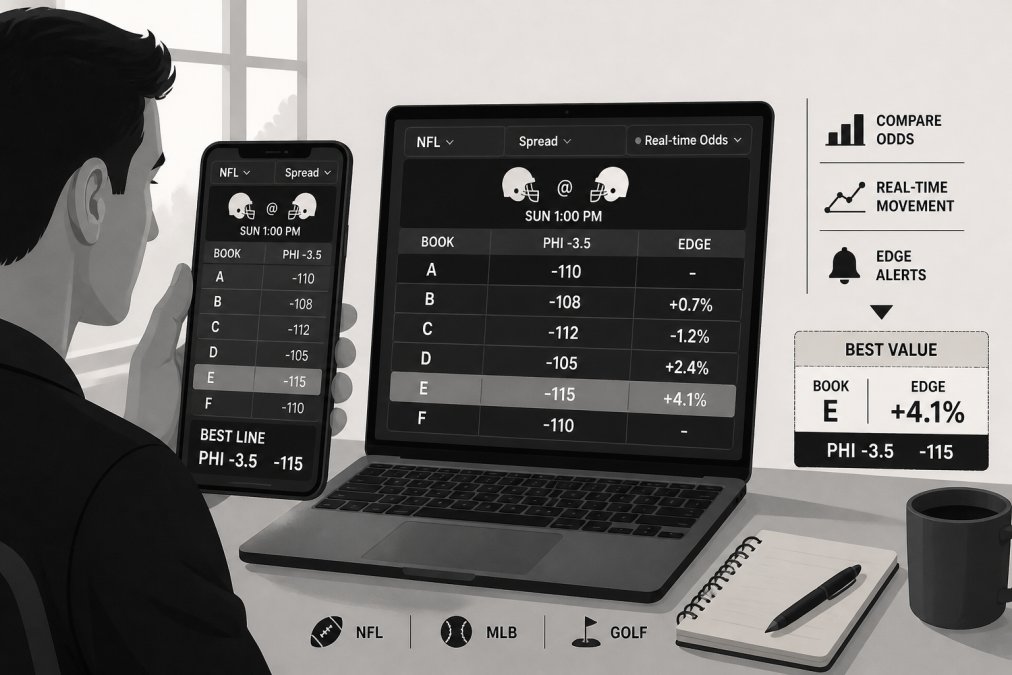
Compare Odds Across Sportsbooks for Mispriced Lines
Different sportsbooks price lines differently. One might have a team at -3.5 while another has -4.5. That half-point difference is worth money over thousands of bets.
Line shopping means checking multiple sportsbooks to find the best number before you bet. It's the most direct path to consistent value.
Line shopping workflow
Step 1: Identify the bet, you've found positive expected value on one side of a matchup.
Step 2: Check that line across your sportsbooks. Serious bettors maintain accounts at 5-10 books, each pricing lines slightly differently.
Step 4: Execute at the best price. Most casual bettors skip this and bet at the first book they open.
Timing and execution
Timing matters because lines move. Once you've identified a mispriced line, you have a window to act before the market corrects it, often minutes, sometimes seconds.
This is where real-time tracking becomes essential. Automated systems scan multiple sportsbooks continuously. When a mispriced line appears, you get alerted immediately via email or text. You can act before the window closes.
Understand Closing Line Value and Validate Your Edge
Closing line value (CLV) is how you know if your edge is real.
Why closing line value matters
The closing line is the final market consensus. It reflects all available information and all sharp money that moved the line.
Many bettors never check this. They win some bets and lose others, then assume they're breaking even. CLV reveals the truth.
CLV is calculated simply: compare the odds you took to the closing line odds. If you took better odds, you have positive CLV.
Tracking results and long-term performance
Track every bet: the date, the bet, the odds you took, the result, and the closing line. After 50-100 bets, look for patterns:
- What sports or bet types show positive CLV?
- Which sportsbooks consistently offer better opening lines?
- Are you beating the closing line consistently?
- What's your actual win rate versus your expected win rate?
This data tells you whether your edge is real or imaginary. Many bettors discover their "edge" disappears when they track CLV honestly. That's valuable information.
Sport Betting Edge logs every pick and provides historical performance data with no cherry-picking. You can validate ROI across multiple seasons. That transparency is rare in the industry. We show everything because our picks hold up under scrutiny.
Common Mistakes to Avoid When Identifying Mispriced Lines
Knowing what not to do is as important as knowing what to do.
Confusing a long shot with a value bet
A long shot has high odds. A value bet has positive expected value. These are not the same thing. A team at +500 odds might be a terrible bet if the true probability is only 15%, the odds look juicy but the math doesn't work. Conversely, a team at -110 might be a great value if the true probability is 55%.
Reacting to single-event noise
One game doesn't prove anything. One week of results doesn't prove anything. One season is borderline.
Bettors see a team lose badly and overreact. "They're terrible now." They bet against them. Sometimes this works. Sometimes it doesn't. The sample is too small to know.
Professional bettors look at 50+ game samples. Casual bettors react to the last game. The difference in accuracy is dramatic.
Ignoring account risk and sportsbook limits
Sportsbooks limit winners. If you're consistently profitable, your account will be restricted, your bet sizes capped, and eventually you might be banned. This is a real constraint that changes the math: you can't just maximize bet size on every positive expected value opportunity, you need to manage your account to stay active and profitable long-term.
Conclusion
Spotting mispriced betting lines requires three things: a systematic method for estimating fair odds, discipline to compare your estimate against market prices, and the speed to act before the market corrects itself on mispriced betting lines.
Sport Betting Edge handles the speed and comparison for you. Our quantitative models identify market inefficiencies across NFL, MLB, and Golf.
Frequently Asked Questions
What is a mispriced betting line?
A mispriced betting line occurs when a sportsbook's odds do not accurately reflect the true probability of an outcome. This creates an opportunity for bettors whose probability estimates differ from the market price. A line is mispriced when the implied probability (derived from the odds) is lower than your calculated probability, offering positive expected value. Identifying these inefficiencies is the core of data-driven sports betting.
How do you use a sports betting expected value calculator to find value?
A sports betting expected value calculator compares your probability estimate against the sportsbook's implied probability. Input your estimated win probability and the odds offered. If the calculated expected value is positive, the bet has value. For example, if you estimate 55% probability on a -110 moneyline (52.4% implied), the +EV signals a potential edge. Consistent positive expected value bets compound into long-term profit.
Can line movement reveal a mispriced betting line?
Yes. Line movement often signals sharp bettors or professional syndicates identifying inefficiencies before the public. If a line moves significantly in one direction, investigate why. However, distinguish between informative movement (reflecting genuine new information) and noise (random betting fluctuations). A line that moves then reverses may indicate the market corrected itself. Closing line value—comparing your entry odds to the final line—reveals whether you captured genuine edges or chased noise.
How do I avoid mistaking a long shot for a value bet?
Long shots have high odds but low implied probability. A value bet requires your probability estimate to exceed the implied probability. Just because odds are high does not mean they are underpriced. Use a fair odds calculator to convert the odds to implied probability, then honestly assess whether your estimate is higher. If a team is 20-to-1 and you estimate 3% probability, that is not value—it is a long shot. Value requires edge, not just attractive payout.