Last Updated: November 24, 2026
Quick Summary
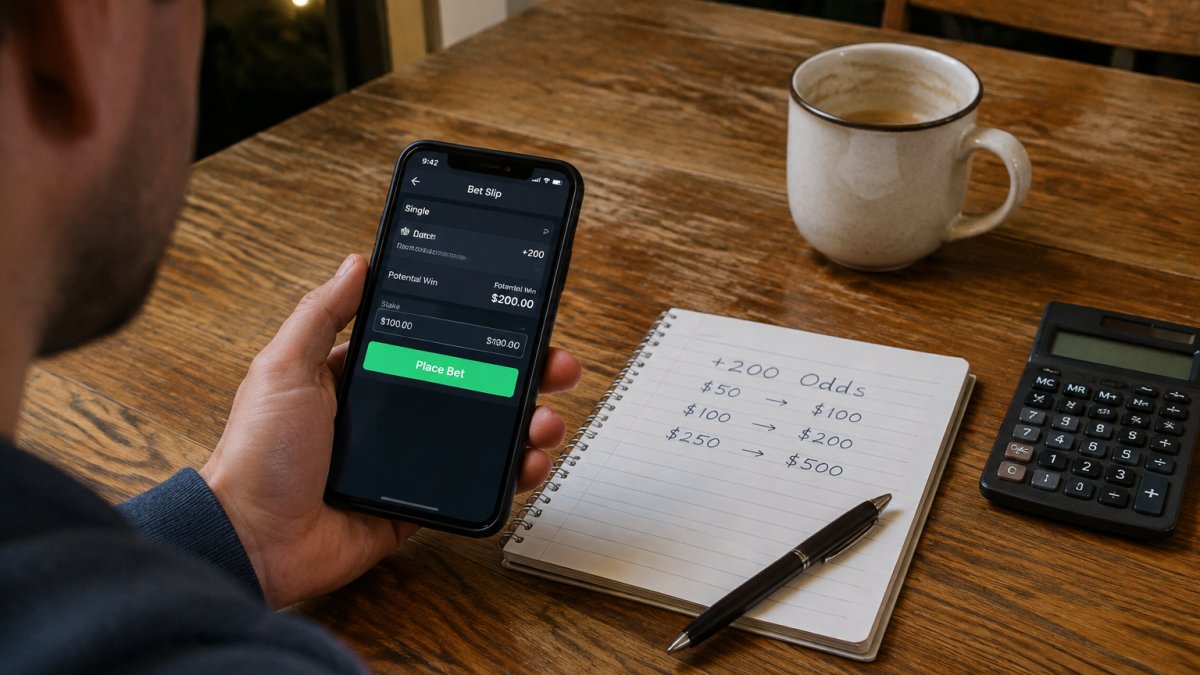
A +200 odds price pays $200 in profit on a $100 bet, and the sportsbook returns $300 in total, stake included. The plus sign means you are backing the underdog, and the number shows your profit per $100 risked.
- At +200, profit is always double the stake and total payout is always triple the stake.
- A $25 ticket at +200 returns $75, while a $500 ticket returns $1,500.
- The implied probability of +200 is 33.3%, calculated as 100 divided by 300.
- Profit is what you gain; total payout is profit plus the stake you get back.
- A +200 price is good only if the true chance of winning beats 33.3%.
Table of Contents
- What +200 Odds Actually Pay on a $100 Bet
- How Much Do You Win on +200 Odds at Every Stake Size
- What Do the Plus and Minus Mean in Sports Betting?
- How to Calculate Implied Probability From Odds
- Decimal Odds Conversion and the Other Formats
- Are +200 Odds Good? Vig, Fair Odds and Line Shopping
- Pushes, Voids and Partial Settlements on a +200 Ticket
- Run Your Own +200 Numbers With the Free Odds Converter
- Frequently Asked Questions
What +200 Odds Actually Pay on a $100 Bet
A +200 price pays $200 in profit on a $100 bet, and the sportsbook returns $300 in total, stake included (Betting Odds Explained: How To Read Betting Odds November 2026). That is the whole answer, and it is the one most guides bury under three paragraphs of preamble. The plus sign tells you the bet is the underdog side of the market. The number tells you the profit per $100 risked.
The New York Times Athletic's beginner's guide to reading betting odds puts the implied probability of a +200 price at 33.33%, or roughly a one-in-three chance. GOAL's betting odds explainer notes that +200 is a common price for underdogs. Both framings matter: one describes what you get paid, the other describes what the market thinks of the bet.
At Edge, we treat +200 as a price, not a prediction. Edge's models cover six sports, and every number we publish is compared against the market's. Below, we walk through what a +200 ticket really pays, how to convert it, and where casual bettors misread it.
How Much Do You Win on +200 Odds at Every Stake Size
The math scales linearly, which makes +200 one of the easiest prices to work with. Double your stake, double your profit. Here is the full picture across common stake sizes, with profit and total return separated so you can see what actually lands in your account.
| Stake | Potential Profit | Total Payout |
|---|---|---|
| $5 | $10 | $15 |
| $10 | $20 | $30 |
| $25 | $50 | $75 |
| $50 | $100 | $150 |
| $100 | $200 | $300 |
| $250 | $500 | $750 |
| $500 | $1,000 | $1,500 |
The pattern is simple to hold in your head: at +200, profit is always double the stake, and total payout is always triple the stake. A $5 ticket returns $15, a $25 ticket returns $75, and a $100 ticket returns $300. When you are ready to size the stake, the Kelly criterion calculator turns your win probability and the odds into a suggested stake. To run your own numbers, use our payout calculator to type a stake and the odds and see the profit and total return.
Profit Versus Total Payout
Profit is the money you gain. Total payout is profit plus the stake you get back. A winning ticket at +200 on a $100 wager returns $300, but only $200 of that is winnings. Mixing the two up is the single most common error we see in bet tracking, and it quietly inflates a bettor's sense of their own returns.
A quick way to catch the mistake: if you record a $300 win on a $100 bet, your bankroll should grow by $200, not $300. The $100 stake was already yours and simply came back. Track profit, not payout, and your records will match your account balance. If you want to check your own numbers, our odds converter takes a stake and a price and shows both figures side by side.
Watch out: some sportsbook bet slips display the total return in large type and the profit in smaller type, so a casual glance can make a $200 profit look like a $300 win. Read the line labeled "to win" or "profit" before you log the result.
Profit and total payout at +200 odds by stake size
What Do the Plus and Minus Mean in Sports Betting?
American odds use a plus or minus sign to show which side of the market you are on and how the price relates to a $100 baseline. A plus number is the underdog: the amount you win on a $100 stake. A minus number is the favorite: the amount you must risk to win $100. So +200 pays $200 on $100, while -200 requires a $200 stake to win $100.
That symmetry is not a coincidence. The two prices are mirror images of each other, and both sit on either side of even money. Bettors who only ever back favorites sometimes never see a plus price at all, which is why the sign confuses people who are new to the moneyline.
How to Calculate Implied Probability From Odds
Implied probability converts a price into the percentage chance the market is assigning it. For positive American odds, the formula is 100 divided by the odds plus 100. For +200 that is 100 / 300, which equals 33.3%.
Run the same formula on any plus price and you get a quick read on how the market sees the bet:
- +150 becomes 100 / 250, or 40%
- +200 becomes 100 / 300, or 33.3%
- +300 becomes 100 / 400, or 25%
- +500 becomes 100 / 600, or 16.7%
Implied Probability Is Not the True Chance of Winning
An implied probability of 33.3% does not mean the bet wins one time in three. It means the sportsbook is pricing the outcome as if it does, after building in its own margin. The true chance could be higher or lower, and the gap between the two is where any edge lives.
This is the distinction most explanations skip. A +200 price on a team the market has mispriced is a good bet. The same +200 price on a team priced correctly is a fair bet. The number alone tells you nothing about value. That is why we compare our own number with the market's before publishing anything, and why every pick we send carries its line, its edge and a suggested stake rather than a bare selection.
Decimal Odds Conversion and the Other Formats
Decimal odds express the same thing as a single number: the total return per unit staked. A +200 price converts to 3.00 in decimal, because $1 staked returns $3. Fractional odds write it as 2/1, meaning two units of profit for every one unit risked. All three formats describe an identical bet.
| Format | +200 Equivalent | What It Shows |
|---|---|---|
| American | +200 | $200 profit per $100 staked |
| Decimal | 3.00 | $3 total return per $1 staked |
| Fractional | 2/1 | 2 units profit per 1 unit staked |
| Implied probability | 33.3% | Market's priced chance of winning |
If you bet across more than one book, you will meet all three. Our odds converter takes any price and returns the other formats plus the implied probability, which saves you doing the arithmetic by hand at the moment a line moves.
Are +200 Odds Good? Vig, Fair Odds and Line Shopping
A +200 price is good only if the true chance of winning is better than 33.3%. Everything else is noise.
Here is the mechanism. For a deeper walkthrough, see how to remove the vig from sportsbook odds. The fair price on the +200 side is therefore a little shorter than the screen number, which means the true break-even chance is closer to 32% than 33.3%. Our no-vig and hold calculator does this in one step.
That distinction matters because the 33.3% figure is a break-even threshold, not a prediction. It tells you the minimum win rate you need at that price to neither gain nor lose before the vig. It says nothing about whether the team will actually win one in three.
Line shopping is the second lever. If one book posts +200 and another posts +210 on the same outcome, the second price lowers your break-even probability and raises your payout for identical risk. To understand why the closing number matters, read what closing line value means in sports betting.
This is where Edge fits. You can read how the models are built on the Models page, and every alert arrives by email and Telegram with its line, its edge, and a suggested stake rather than a bare selection.
Watch out: a price that looks generous at +200 can still be the worst number in the market if three other books are posting +215. Always compare before you click, and remember that a better price changes your break-even probability, not just your payout.
Pushes, Voids and Partial Settlements on a +200 Ticket
A +200 ticket does not always win or lose cleanly. Three outcomes sit in between, and each one settles differently.
- Push: the result lands exactly on the number, so the stake is returned and the bet is graded as a no-action. No profit, no loss.
- Void: the market is cancelled, often because of a postponement or a lineup change. The stake comes back in full.
- Partial settlement: some markets, such as those with dead-heat rules, pay a reduced return rather than the full +200.
Watch out: a pushed or voided leg in a parlay can change the entire ticket's payout, not just that leg. Check the sportsbook's rules before you assume a +200 price always returns double.
Run Your Own +200 Numbers With the Free Odds Converter
The fastest way to internalize +200 is to convert it yourself a few times. Type the price into our free odds converter and you will see the decimal and fractional equivalents alongside the implied probability, which makes the relationship between price and chance click.
Once the conversion is second nature, the next step is sizing. A price tells you what a bet pays. It does not tell you how much to stake. Edge sends every pick with its line, edge and a suggested stake by email and Telegram, and every pick is logged and graded in public on the Records page so you can see the full history before you commit.
The challenge with +200 is not the arithmetic. It is discipline: converting the price, checking the implied probability against your own read, shopping for the best number, and sizing the stake so a cold run does not wipe you out. Edge was built for exactly that workflow. Edge covers six sports, every alert arrives with its line, edge and suggested stake, and every plan starts with a 10-day free trial.
Sports betting involves risk. Past results do not guarantee future results. Bet only what you can afford to lose.
Frequently Asked Questions
What does +200 mean on odds?
It means a winning $100 bet returns $200 in profit, plus your $100 stake back, for $300 total. The plus sign marks the underdog price, so the sportsbook is pricing that outcome as less likely than the favorite. The implied probability of +200 works out to 33.33% by the standard formula, which is a one-in-three chance once you convert the price. That is the break-even rate, not a forecast of the result.
How much do you win on +200 odds if I stake $25 or $50?
Multiply your stake by 2 to get the profit. A $25 bet wins $50 profit and returns $75 total. A $50 bet wins $100 profit and returns $150 total. A $10 bet wins $20 profit and returns $30. The ratio never changes, only the size of the stake, so a smaller bankroll gets the same price as a large one.
How do I convert +200 odds to decimal odds?
Divide the American number by 100 and add 1. So 200 divided by 100 is 2, plus 1 gives decimal odds of 3.00. Decimal odds show the total return per unit staked, which is why $100 at 3.00 returns $300. For negative odds, divide 100 by the absolute number and add 1, so -200 becomes 1.50. A free odds converter handles both directions instantly.
Are +200 odds good?
Only if the true chance of winning is better than the 33.33% the price implies. A +200 underdog that wins 40% of the time is a value bet; one that wins 25% of the time is a losing bet even when it cashes. Compare the price across sportsbooks too, because the same team can sit at +200 at one book and +210 at another, and that difference adds up over a season.
